
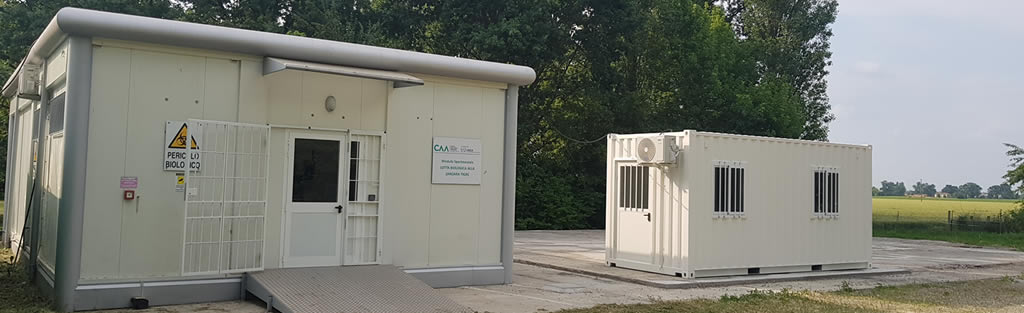
The Biosafety Level 3 (BSL-3) Laboratory of the Sanitary Entomology & Zoology Dept. at the C.A.A. “G. Nicoli” is organized in accordance with international guidelines.
This facility has special engineering and containment features that allow investigators to work safely with animal and human pathogens classified at level 3 (Allegato XII, 626/94) transmitted by mosquitoes and other vectors, that have high risks for the lab personnel but low risks for the community.
The overall management of the Laboratory is conducted in accordance with the requirements of the
UNI EN ISO 9001 Company Quality System. Since April 2015, CAA has achieved ISO 14001 environmental certification. It therefore operates according to international standards that guarantee the accuracy of its programs and activities, based on verifiable procedures that adhere to a precise corporate quality and environmental policy. The principles and procedures of the quality system applied to laboratory management guarantee the traceability of the tests conducted and the quality of their results.

IAEA Collaborating Centre
From December 2011, the Centro Agricoltura Ambiente “G. Nicoli” has been designated as Collaborating Centre of the International Atomic Energy Agency (IAEA – Insect Pest Control Section), Vienna. CAA has been reconfirmed as CC IAEA till 2026.
An IAEA Collaborating Centre is a scientific institution that assists the Agency in implementing its program through research, application development and training in relevant nuclear technologies.
Designation as a Collaborating Centre is a public recognition of the work and the internationally scientific role that the institution cover in a specified field and as an expression of strong collaboration by the Agency.
The work project defined in agreement with IAEA covers the development and validation of technologies and methods for the application of the Sterile Insect Technique (SIT) focused on Aedes mosquitoes.
The overall objective of the collaboration is to further develop and improve the SIT technology for Aedes mosquitoes including mass rearing and quality control methods, field testing of the developed methods, strategies validation under natural field conditions as well as training of researchers coming from developing countries.

The laboratory
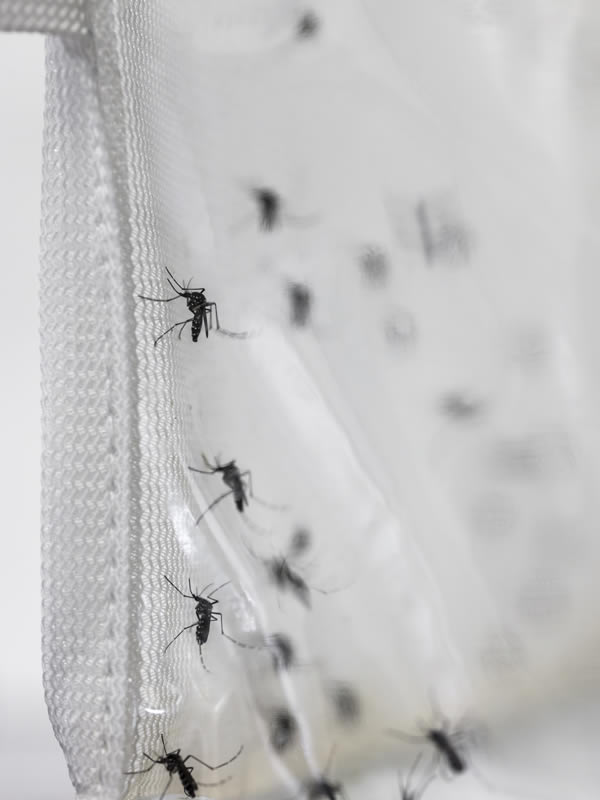
The biological material available in the laboratory is obtained from closed-cycle and continuous breeding of mosquito species such as Culex pipiens molestus (common mosquito) and Aedes albopictus (tiger mosquito) and predatory microcrustaceans such as Macrocyclops albidus.
Furthermore, tests are regularly carried out there to determine the resistance levels of culicidae larval populations in areas that have been subjected for years to control with Bacillus thuringiensis var. israelensis and Diflubenzuron.
The availability of 3 independent air-conditioned cells (10.2 m2) designed to guarantee perfect functioning and stability of the set conditions (Temperature, Relative Humidity and Photoperiod), allows the safe breeding of Ae. albopictus males to be used in the release of sterile males in the context of control trials using the SIT method.
The BL3 laboratory is equipped with equipment that allows technicians to operate safely:
- Safety cages for the maintenance of infected and/or infectious insects;
- Class II biological safety cabinet;
- Autoclave for decontamination of equipment and materials;
- Decontamination and biological waste disposal system in accordance with current regulations.
Mass rearing experimental unit
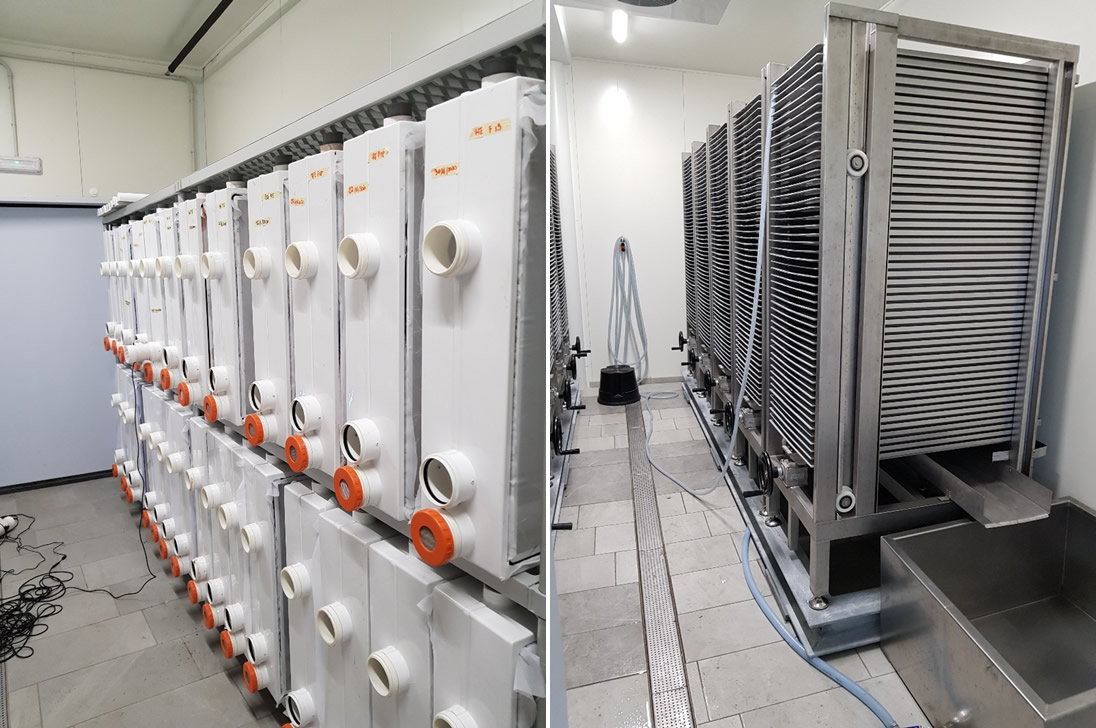
In order to scale up the production of sterile Aedes males, CAA has developed a SIT facility module with a maximum production capacity of about 1,000,000 sterile males per week. The module has two large climatic controlled chambers of 18 sqm each and a laboratory area of about 45 sqm. The module is equipped with a salt-based water softener, a water heater control system and a mechanical 200-micron reusable water filter to assure the confinement of the larval stages in the rearing unit.
The module has a controlled access and a filtered air circulation system to avoid the escape of adult insect stages. The module has therefore a biosafety containment level BSL2 capable to allow the mass production of invasive Aedes species.
The CAA SIT module is equipped with racks, trays and adult mass production cages and it has reached a capacity production of 14,700,000 sterile males in 2023.
From 2022 our facility has provided by an X-ray maschine for sterilizing insects.